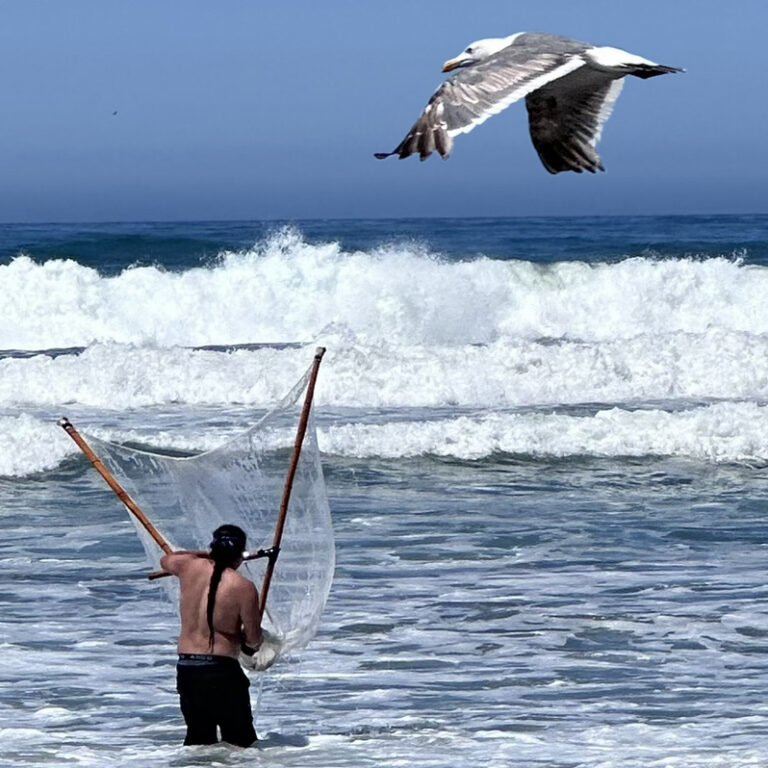


The Yurok and Tolowa Dee-ni' people are coastal neighbors that have common cultural traditions, ceremonies, stewardship practices, habitats and species, and are interconnected through marriage, trade, and other ways.

Yurok and Tolowa Dee-ni' people today constitute several distinct federally recognized Tribal governments that, through some of their Constitutions, assert a small area of overlapping ancestral lands and waters at the southern/northern boundary of their respective territories. Anthropogenic causes post-colonization is having detrimental impacts to the ancestral lands, waters, and citizens of these Tribal governments. To honor and respect our connections as people Indigenous to this place, there is a need for inter-Tribal government collaboration and assertion of Tribally designated stewardship in the lands and waters of the Yurok and Tolowa Dee-ni' people.

About the Yurok-Tolowa Dee-ni'
Indigenous Marine Stewardship Area

We are committed to collaboratively stewarding and managing the Yurok-Tolowa Dee-ni' Indigenous Marine Stewardship Area to ensure the protection of biodiversity, the sustainability of our traditional practices, and the resilience of our communities. It is with a deep sense of responsibility, honor, and good faith that we take this critical step toward advancing Indigenous-led conservation.

  • Tribal Governments

    Pulikla Tribe of Yurok People (formerly Resighini Rancheria)
    IMSA designation declared June 14, 2023
    The Pulikla Tribe of Yurok People remains on the lands and waters where our ancestors have survived since noohl hee-kon (the beginning). This includes the lower Klamath River and tributary watersheds, high country, coast, and lagoons along the Pacific Ocean, and the ocean west to the horizon.

    Cher-Ae Heights Indian Community of the Trinidad Rancheria
    IMSA designation declared July 13, 2023
    Trinidad Rancheria’s citizens descend from Yurok, Wiyot, and Tolowa peoples who have lived for thousands of years in the coastal redwood region of Northern California. Established in 1906 within Yurok homelands, the Rancheria sustains sacred shores and nearshore waters, strengthening cultural continuity and caring for these places for future generations.

    Tolowa Dee-ni' Nation
    IMSA designation declared August 10, 2023
    Tolowa Dee-ni' (people) live throughout Taa-laa-waa-dvn (Tolowa-Ancestral-Land), which lies along the Pacific Coast between the watersheds of; Wilson Creek and Smith River in California, and the Winchuck, Chetco, Pistol, Rogue, Elk and Sixes Rivers, extending inland up the Rogue River throughout the Applegate Valley in Oregon.

  • Geography

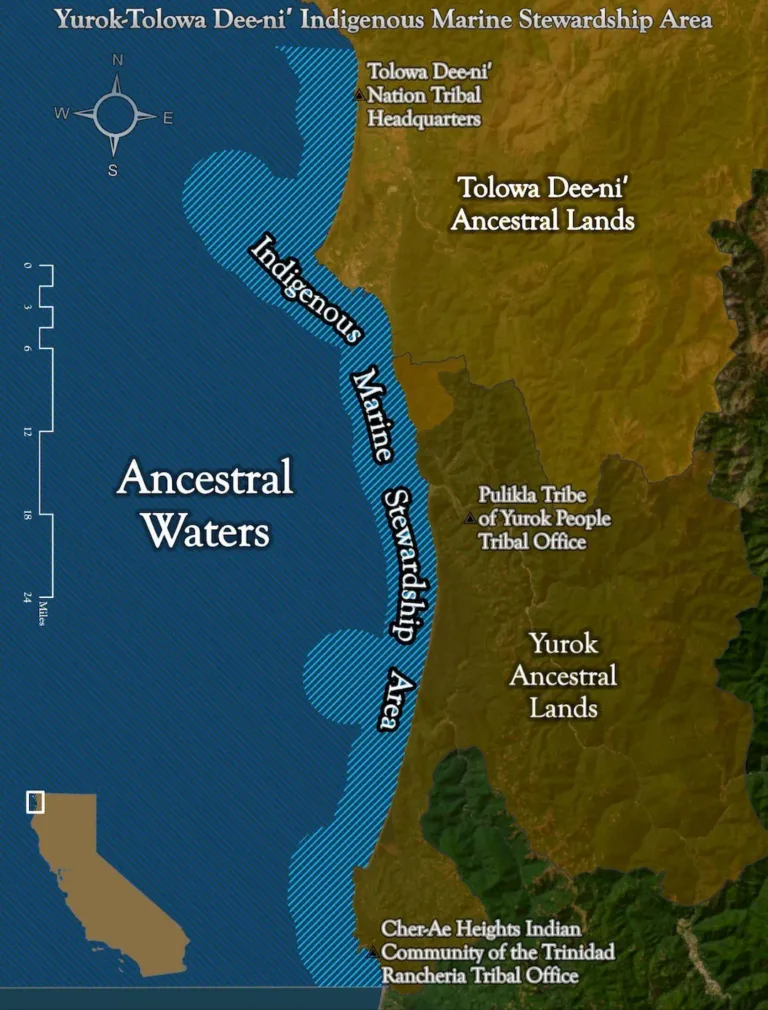
    California/Oregon border (north) to Little River (south), mean high tide (east), and out three (3) nautical miles beyond the outermost islands, reefs, and rocks, and include all waters between those and the coast (west). The designated IMSA includes waters shared with the State of California, however, it is not the full extent of ancestral waters of the Tribal Nations.

  • Cultural Keystone Species + Important Ecological and Cultural Habitats

    Abalone, candlefish/eulachon, clams, eels/lamprey, mussels, seaweed, kelp, salmon, green sturgeon, salmon, seabirds and shorebirds, seals, sea lions, surf and night smelts, whales.

    Rocky intertidal, sandy beach, nearshore ocean, coastal marsh and wetlands, estuary, offshore rocks, rocky reefs, and kelp forests.

  • Ecological Concerns

    Need for enhanced Tribal stewardship and practices. Concerns about water quality, pollution, coastal erosion, oil and gas development, offshore wind and wave energy development, invasive species, ocean acidification, hypoxia, harmful phytoplankton blooms, species and habitat loss, sea level rise, and other climate impacts.

What are Indigenous Marine Stewardship Areas (IMSAs)?

Tribal Nations have inherent rights and responsibilities to govern, steward, and manage ancestral lands and waters. In California, these unceded rights and responsibilities continue to be asserted by Tribal governments in both State and Federal forums. Federally recognized Tribal governments are sovereign nations and have the governance authority to manage their lands, waters, and Tribal citizens. This authority allows for the protection and preservation of ocean and coastal territories through Tribal stewardship initiatives and the utilization of Indigenous traditional knowledge (ITK). Reclaiming unceded ancestral lands and waters, coupled with asserting Tribal sovereignty and traditional rights, will lead to enhanced biodiversity, address climate impacts, and will support cultural lifeways and economies.

  • Definition

    Indigenous Marine Stewardship Areas (IMSAs) are defined geographies in ocean and coastal waters that are designated by a Tribal Nation(s) to achieve long term stewardship, management and co-management of ecosystem services, and support cultural lifeways and economies.

  • Intent

    The intent of IMSAs is to reclaim and return Tribal ocean and coastal waters to Tribal governance and stewardship, to support cultural lifeways and economies, to enhance biodiversity, and to provide durable conservation measures designed to protect and restore ocean health that are rooted in Indigenous traditional knowledge (ITK).

  • Authority for Designation

    Tribal Constitutions of federally-recognized, sovereign Tribal Nations.

  • Tribal Governance, Stewardship, and Management

    To fulfill governance, stewardship, and management responsibilities for an IMSA, it is essential that a federally-recognized Tribal nation has the capacity to fulfill this role. To be successful, this capacity must be programmatic. Programmatic capacity is demonstrated when Tribal nations have access to sustainable, non-competitive funding, have growing expertise in marine ecosystem management and Indigenous knowledge, and mechanisms in place that allow for robust community engagement. An emerging example of a collaborative way to develop necessary programmatic capacity is the Tribal Marine Stewards Network (TMSN). Find out more at tribalmsn.org.

How Do IMSAs Fit Within a California Context?

IMSAs are a mechanism to establish Tribally-led stewardship that is critical to the success of the State of California’s ambitious goals for conservation, biodiversity, climate smart lands and waters, and Tribal engagement. IMSAs align with several of the State of California’s policies, and Tribal Nations must be given the opportunity and the funding to lead conservation efforts through action, and incorporation of traditional management strategies that move California toward its biodiversity goals. The following are current California policies and laws connected to and/or achieved by implementing IMSAs.

SEPT 2011

California Executive Order B-10-11

Recognizes and reaffirms the inherent rights of Tribes to exercise sovereign authority over their members and territory. Establishes the Governor’s Tribal Advisor within the Governor’s Office. Directs every state agency and department subject to executive control to communicate and consult with California Tribes.

June 2019

California Executive Order N-15-19

Acknowledges California’s relationship with California Tribes was violent, exploitative, dispossessory, destructive, and warmongering; and formally apologizes. Reaffirms that the Governor’s Tribal Advisor and Administration shall engage in government-to-government consultation and establishes the Truth and Healing Council that will deliver written findings.

Sept 2020

California Governor’s Statement of Administration Policy on Native American Ancestral Lands

Directs State agencies to partner with California Tribes to facilitate access, use, and co-management of State owned or controlled lands and work to help Tribes acquire lands “in excess of state needs.”

Oct 2020

California Executive Order N-82-20 - Nature Based Solutions Executive Order

Declares California must work to mitigate greenhouse gas emissions, accelerate planning and implementation of “nature-based solutions” for climate resilience, and work in partnerships collaboratively with California Tribes and others. Directs various agencies to implement actions toward the goal to conserve at least 30% of State land and coastal waters by 2030.

Apr 2022

California’s Pathways to 30x30: Accelerating Conservation of California’s Nature

California’s strategy for achieving commitments of EO-82-20, in which the State committed to conserving 30% of lands and coastal waters by 2030. This strategy consists of ten pathways for conserving an additional six million acres of land and half million acres of coastal waters needed to reach 30%. The Ocean Protection Council has explicitly identified IMSAs as one strategy toward meeting the State’s 30×30 goal for coastal waters.

Today

California’s Marine Protected Areas

The State of California has designated a network of 124 Marine Protected Areas (MPAs) that cover 16.12% of State coastal and marine waters.

Today

Tribal Marine Stewards Network (TMSN)

The Tribal Marine Stewards Network aims to return stewardship and management of ocean and coastal territories to California’s Tribes. The State of California, through the Ocean Protection Council, has demonstrated commitment to the TMSN in their current Strategic Plan. All Tribal Nations that have designated the Yurok-Tolowa Dee-ni' IMSA are members. Find out more at tribalmsn.org.

How Do IMSAs Fit Within an International Context?

United Nations Declaration on the Rights of Indigenous Peoples (UNDRIP) declares the rights of Indigenous peoples to all human rights and fundamental freedoms as recognized in the Charter of the United Nations, the Universal Declaration of Human Rights and the rest of international human rights law, and outlaws discrimination against Indigenous peoples. UNDRIP specifically highlights: The rights of Indigenous peoples to live in dignity, maintain and strengthen their own institutions, cultures, and traditions, and pursue their self-determined development. The right to self-determination, including maintaining and strengthening their distinct political, legal, economic, social and cultural institutions, while retaining their rights to participate fully in all matters that concern them, if they choose to, in the political, economic, social, and cultural life of the state. Subsistence rights, and rights to lands, territories, and resources. Rights to just and fair redress, for Indigenous peoples deprived of their means of subsistence and development.

Our Work

Check back soon for an update to this section.
Have questions? Please email us for more information.

Conclusion

Tribal Nations have a responsibility to protect and preserve ocean and coastal territories for future generations. Tribes draw from centuries of Indigenous knowledge and stewardship practices that support healthy ecosystems and marine environments. Returning stewardship and management of ocean and coastal territories to Tribes is essential to meet conservation goals and to address climate change impacts. Indigenous communities across the world are creating stewardship areas, conservation areas, and protected areas which are replicable models that have been proven successful. Indigenous communities have also developed sustainable capacity to monitor and enforce their ancestral lands and waters through successful programs like the Indigenous Guardians and Indigenous Rangers.

Tribes in California will be leaders in marine conservation in the United States through the designation of Indigenous Marine Stewardship Areas and the enhancement of Tribal stewardship capacity. IMSAs will sustain and revitalize Indigenous knowledge and access to traditional foods, create jobs and workforce development, strengthen community health and wellbeing, protect marine biodiversity and ocean health, promote sovereignty and respect for Tribal governance, and promote collaboration and build strong government-to-government relationships between Tribes and State and Federal partners for the purposes of co-governance and co-management.

Contact Us

Interested in more information, ways to support our work, or something else? We look forward to hearing from you!
Email us: Hello@yuroktolowaIMSA.org